
 [German]The option for companies to defer use of the Outlook New app to Outlook Classic was originally scheduled to end in April 2026. Microsoft has now postponed this date by 12 months to March 2027.
Planned switch to Outlook New app for April 2026
Microsoft has been working for years to replace Outlook Classic with the Outlook New app. Microsoft actually wanted to start switching corporate users to the new Outlook app in early 2025. It was actually announced that users with a Microsoft 365 Business Standard and Premium license would switch to the new Outlook for Windows starting January 6, 2025 – I also mentioned this in my blog post Migration from Outlook Classic to New Outlook starts for business customers at the beginning of 2025 in early 2025 for business customers.
In 2025, it became known that this transition would actually take a little longer. In my blog post Migration to new Outlook app for enterprise user in April 2026 I reported that Microsoft was postponing this mandatory transition for businesses until April 2026.
At the time, Microsoft indicated in a statement that it now wanted to give customers (with Enterprise licenses) more than 12 months to prepare for the change. Starting in April 2026, users with Microsoft 365 for Enterprise licenses were supposed to be automatically switched from the classic Outlook for Windows to the new Outlook app for Windows. Supposed to be…
MC949965: Toogle to new Outlook postponed to March 2027
On February 20, 2026, Microsoft postet a notice MC949965 – Toggle to new Outlook in the Microsoft 365 Message Center, stating that the mandatory switch to the new Outlook app, originally planned for April 2026, will not take place.
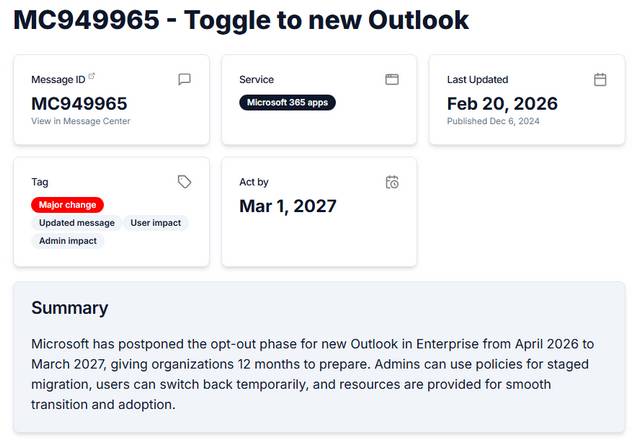
Microsoft has announced that it will postpone the opt-out phase for the new Outlook for corporate customers with Enterprise subscriptions from April 2026 to March 2027. Companies will now have 12 more months to prepare. This is already the second 12-month extension of this transition date.
Microsoft writes that administrators can use guidelines for a gradual migration. Users can temporarily switch back to Outlook Classic. Microsoft wants to provide resources for a smooth transition and rollout.